
There is, actually significant discussion among millions of central government employees, and pensioners about the 8th Pay Commission. The main worry for workers is how much their pay might go up once the new pay commission comes into effect, plus what it could mean for staff across Levels 1 to 10. In general, the objective of the 8th Pay Commission is to revisit matters tied to the salaries, allowances and also pensions of government employees. Because inflation is going up, and everyday household expenses are also climbing, many employees are expecting that the upcoming pay structure may give a bit of financial relief. Still, any guesses about the new pay matrix, the fitment factor, or the final salary structure are only speculative until official approval is granted. So, calculations from salary calculators should not be treated as final, or set in stone.
8th Pay Commission 2026: What is the Pay Matrix for Levels 1 to 10?
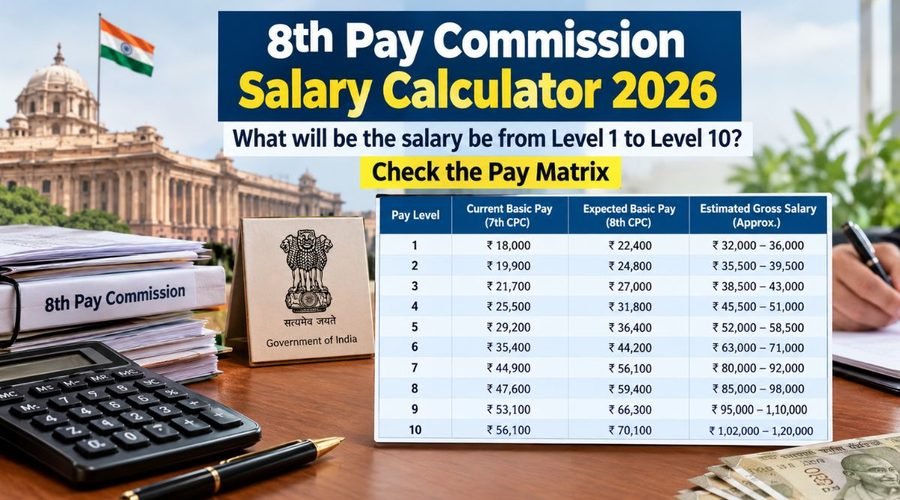
The current pay structure for central government employees has a variety of levels inside a pay matrix. Each level is basically tied to an employee’s role in position and pay scale. Take a simple example: the starting basic pay is ₹18,000 for Level 1 , and it goes up to ₹56,100 for Level 10. In real life an employee’s actual basic salary depends on how they were initially appointed, where they sit in the current pay level, and what increments they have earned over time. So even if these existing pay levels may get reviewed under the 8th Pay Commission, the exact starting salary for every level in the new pay matrix will not really be known until official recommendations are out and the government makes its decision. Because of that, employees should estimate what their potential pay rise might be by looking at their current basic pay and thinking from there.
How might the Fitment Factor determine the new salary?
The fitment factor is one of the most critical topics that usually comes up when people talk about the 8th Pay Commission, it kind of works like a multiplier that people use to gauge a possible new basic pay from an employee existing basic pay. For instance, if someone’s current basic salary is ₹18,000 and a fitment factor of 2.00 is applied just for example, then the new basic pay would turn out to be ₹36,000. Likewise, if the same multiplier is used on a basic pay of ₹25,000 then the estimated figure becomes ₹50,000. Please keep in mind, though, these are only illustrative examples and not a promise. In real terms, the final fitment factor, and the real salary increase under the 8th Pay Commission, can be different. So, one should not treat any number that is based on an estimated multiplier as final, or as definitive.
8th Pay Commission: Expected Salary Revisions for Central Govt Employees (As per media reports)
Level 1 (Peons, Attendants, Support Staff)
- Current Basic Pay: ₹18,000
- Revised Basic Pay: ₹51,480
- Increase: ₹33,480
Level 2 (Lower Division Clerks)
- Current Basic Pay: ₹19,900
- Revised Basic Pay: ₹56,914
- Increase: ₹37,014
Level 3 (Constables, Skilled Public Service Staff)
- Current Basic Pay: ₹21,700
- Revised Basic Pay: ₹62,062
- Increase: ₹40,362
Level 4 (Grade D Stenographers, Junior Clerks)
- Current Basic Pay: ₹25,500
- Revised Basic Pay: ₹72,930
- Increase: ₹47,430
Level 5 (Senior Clerks, Higher-Level Technical Staff)
- Current Basic Pay: ₹29,200
- Revised Basic Pay: ₹83,512
- Increase: ₹54,312
Level 6 (Inspectors, Sub-Inspectors)
- Current Basic Pay: ₹35,400
- Revised Basic Pay: ₹1,01,244
- Increase: ₹65,844
Level 7 (Superintendents, Section Officers, Assistant Engineers)
- Current Basic Pay: ₹44,900
- Revised Basic Pay: ₹1,28,414
- Increase: ₹83,514
Level 8 (Senior Section Officers, Assistant Audit Officers)
- Current Basic Pay: ₹47,600
- Revised Basic Pay: ₹1,36,136
- Increase: ₹88,536
Level 9 (Deputy Superintendents of Police, Accounts Officers)
- Current Basic Pay: ₹53,100
- Revised Basic Pay: ₹1,51,866
- Increase: ₹98,766
Level 10 (Group A Officers, Entry-Level Civil Services)
- Current Basic Pay: ₹56,100
- Revised Basic Pay: ₹1,60,446
- Increase: ₹1,04,346
How to calculate potential salary for Levels 1 to 10?
To estimate your possible salary, first figure out your current basic pay. Then, multiply that basic pay with the fitment factor you want to use, kinda like for the calculation part. For example, if an employee at Level 1 has a current basic pay of ₹18,000 and estimates their salary using a fitment factor of 2.28, the math is like: ₹18,000 × 2.28 = ₹41,040. Remember this is only a sample calculation, not the official new salary. In the same way, employees across Levels 2 to 10 can work out different possible scenarios using their current basic pay, though it’s still just what-if. Still, the real final salary will depend on the pay matrix, the pay fixation rules, and the recommendations that the government actually approves.
Will the 8th Pay Commission lead to a doubling of salaries?
A lot of employees are curious if their salaries can sort of double once the 8th Pay Commission is put in place. But as of now, it is not really possible to give a hard, definitive answer. Yes, the new basic pay can be estimated using a fitment factor , however the increase in basic pay on paper is a different thing compared to what an employee actually sees in total income. Also, the new pay structure could shift how the Dearness Allowance (DA) is worked out, and other allowances as well, so the overall rise can’t be decided just by staring at the “fitment factor” alone. What the person finally benefits from will hinge on the exact pay structure that the government approves and the effective date from which it starts.
8th Pay Commission Salary Calculator 2026: What should employees keep in mind?
When reading news regarding the 8th Pay Commission, employees should try to distinguish between official information and speculative, almost guessing figures. Definitive details about the new basic pay, the fitment factor, the pay matrix and the arrears will only get clear once official government announcements come out , and when formal implementation orders are issued. Employees should keep their current basic pay, pay level, and other salary-related details ready to hand so that they can compute their updated salary as soon as the official changes are announced. Pensioners should also watch the rules closely, plus the official directives concerning pension revisions.
Conclusion
The 8th Pay Commission Salary Calculator 2026 can be kind of useful tool for central government employees, ranging from Level 1 to Level 10 who want to guess their possible new salary. One might estimate the projected pay by using their current basic pay along with different imagined fitment factors, but do not mix it up with a real salary hike. The final pay matrix, the exact fitment factor, and the actual effective date of rollout will only be confirmed after an official government order, so until that point it’s better to treat the results as a rough idea not a promise. Because of that, employees should keep checking the latest official notices and avoid considering any speculative numbers as their final, officially confirmed new salary.